Muscle & movement
Skeletal muscle is not just a contractile tissue — it is the largest hormone-producing organ in the body. When muscles contract, they release signalling molecules (called myokines) that regulate metabolism, immune function, inflammation, and brain health throughout your entire body.
Cardiorespiratory fitness and muscle strength are independent predictors of all-cause mortality. Low fitness rivals smoking, diabetes, and hypertension as a risk factor. Grip strength alone predicts cardiovascular mortality across 17 countries. Muscle mass and function are not vanity metrics — they are survival metrics.
For practical programming — exercise selection, training frequency, HIIT, zone 2 cardio, and daily movement — see the training module.
Key takeaways
- Cardiorespiratory fitness is among the strongest predictors of all-cause mortality — rivalling smoking, diabetes, and hypertension as a risk factor
- Grip strength predicts cardiovascular death across 17 countries and 140,000+ participants
- Sarcopenia starts around age 30, accelerates after 50 — resistance training combined with adequate protein is the only intervention with strong evidence
- Muscle is a hormone-producing organ: myokines from contracting muscle regulate metabolism, immunity, and brain health
- Muscle grows through mechanical tension → satellite cell activation → muscle protein synthesis — progressive overload drives this process
- Body recomposition (gaining muscle while losing fat) is possible with high protein intake and moderate deficit, not only for beginners
- Minimum dose: 2 resistance sessions/week + 150 min zone 2 cardio/week
- See klatiPRO for the full daily protocol that integrates training, nutrition, and supplementation
For supplement and product reviews, see klatiCHECK.
How muscle grows
Understanding the growth process helps explain why specific training principles matter.
- Mechanical tension — when a muscle contracts under load, mechanosensors in the muscle fibres detect strain and initiate a signalling cascade (mTOR pathway) that triggers muscle protein synthesis (MPS).
- Satellite cell activation — muscle stem cells (satellite cells) surrounding the fibres donate nuclei to damaged or stressed fibres, expanding their capacity to produce protein. This is why progressive overload works: increasing tension recruits more fibres and activates more satellite cells.
- Muscle protein synthesis > muscle protein breakdown — if MPS exceeds breakdown over a 24–72 hour window after training, the fibre adds contractile protein (actin and myosin) and grows. Protein intake and sleep are the primary regulators of this balance.
The practical consequence: any program that progressively increases mechanical tension, provides sufficient protein, and allows recovery will build muscle. The training principles below serve these three requirements.
Sarcopenia — the silent epidemic
Sarcopenia is age-related loss of muscle mass and function. It begins around age 30 and accelerates after 50, with losses of 3–8% of muscle mass per decade in untrained individuals.
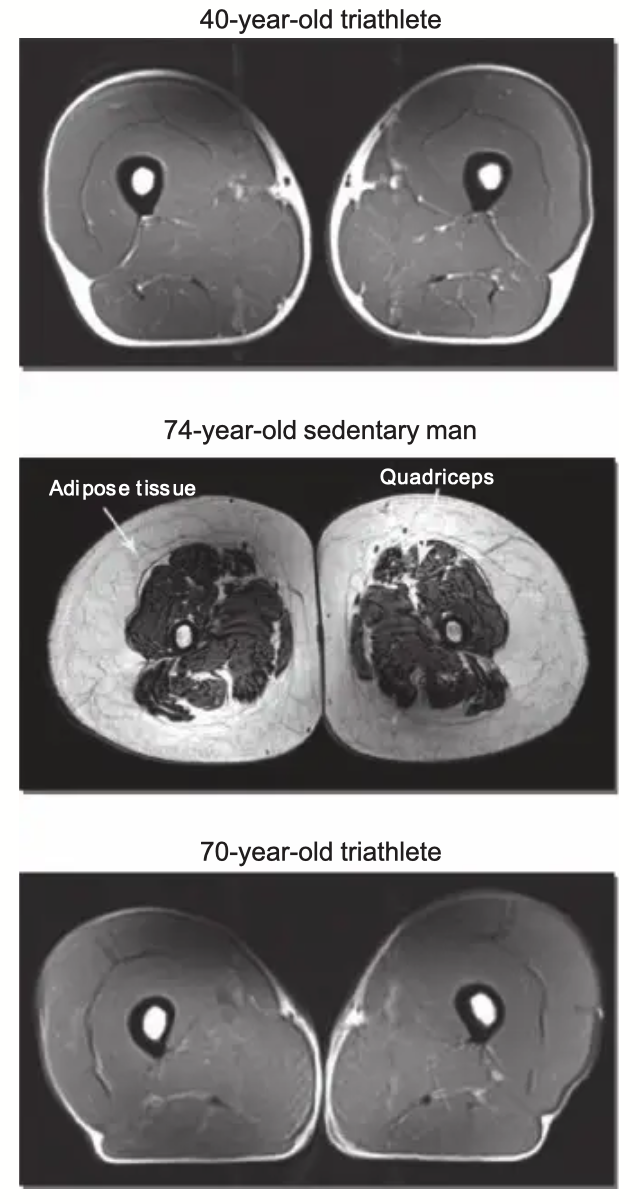
Wroblewski et al., 2011 — Chronic Exercise Preserves Lean Muscle Mass in Masters Athletes
The revised European consensus defines sarcopenia by three criteria:
- Low muscle strength (grip strength or chair-stand test)
- Low muscle quantity/quality (DXA, BIA, or CT)
- Low physical performance (gait speed, TUG test)
Sarcopenia is now classified as a disease (ICD-10: M62.84). It increases fall risk, fracture risk, hospitalisation, disability, and mortality. The only treatment with strong evidence is resistance training combined with adequate protein intake. No drug currently matches exercise for reversing established sarcopenia, though GLP-1 agonists and myostatin inhibitors are under investigation.
Resistance training
A 2011 meta-analysis (Peterson et al.) of resistance training interventions in older adults found:
- Resistance training increases lean body mass even in adults over 70.
- Progressive overload is required — the stimulus must increase over time.
- Frequency of 2–3 sessions per week with compound movements produces the most reliable outcomes.
- Strength gains come before visible muscle growth; your nervous system adapts first.
Minimum effective dose for health-span benefits: 2 sessions/week targeting major muscle groups with progressive overload.
Optimal for muscle growth: evidence supports a dose-response relationship up to at least 10 sets per muscle group per week (Schoenfeld et al. 2017). The commonly cited 10–20 set range has diminishing returns in the upper range — the categorical analysis comparing <5, 5–9, and 10+ weekly sets reached only p=0.074. Practically: most people benefit from 10–15 hard sets per muscle group per week; going above 20 is unlikely to add meaningful hypertrophy and may impair recovery.
For exercise selection, weekly programming, and HIIT protocols see the training module.
Training principles
These matter more than program specifics:
- Progressive overload: Systematically increase load, volume, or difficulty over time. This is the single most important driver of long-term muscle growth.
- Compound movements: Squat, deadlift, press, row, and pull-up patterns cover most muscle groups efficiently and allow the heaviest loads.
- Proximity to failure: Sets taken within 1–3 reps of failure produce significantly greater hypertrophic stimulus than sets stopped well short of failure (Refalo et al. 2022, meta-analysis). However, taking every set to absolute failure increases fatigue disproportionately — reserve true failure for the last set of an exercise.
- Rest periods: Longer rest between sets (2–3 minutes for compound lifts) produces greater strength and hypertrophy gains than short rest (≤60 seconds), because it allows higher-quality subsequent sets (Schoenfeld et al. 2016).
Recovery
Muscle grows during rest, not during training. Inadequate recovery limits gains regardless of training quality.
- Sleep: Sleep restriction decreases anabolic hormones (testosterone, IGF-1) and increases catabolic markers (cortisol, myostatin). A single night of poor sleep measurably shifts the balance toward muscle protein breakdown (Dattilo et al. 2011). Aim for 7–9 hours. See the sleep module.
- Protein timing: Distribute protein across 3–4 meals with ≥2.5 g leucine per meal to maximise MPS throughout the day. A dose within 2–3 hours of training supports the post-exercise MPS window, though total daily intake matters more than precise timing. See the protein module.
- Deload periods: Planned reductions in training volume or intensity every 4–8 weeks allow accumulated fatigue to dissipate. Deloading is not lost time — it prevents overreaching and maintains long-term progression.
- Signs of underrecovery: persistent soreness beyond 72 hours, declining performance across sessions, poor sleep quality, elevated resting heart rate, and increased injury frequency.
Cardiorespiratory fitness and VO2max
VO2max (maximal oxygen uptake) is the gold standard measure of cardiorespiratory fitness. It reflects how efficiently your body delivers and uses oxygen during maximal exertion. It is measured in mL/kg/min — higher values mean better aerobic capacity.
A major study of over 122,000 patients (Mandsager et al. 2018) found that cardiorespiratory fitness was inversely associated with all-cause mortality with no upper limit of benefit. Extremely fit individuals had ~80% lower mortality risk compared to the least fit. This was dose-dependent across the entire fitness spectrum — not a threshold effect.
The single biggest return on investment: moving from “Poor” to “Below average” fitness produces the largest mortality reduction (~20% absolute). Every step above that continues to reduce risk, but the first step out of sedentary living provides the most dramatic benefit.
VO2max by age, sex, and mortality risk
VO2max values in mL/kg/min. Fitness categories based on ACSM percentile norms; mortality-risk reduction relative to the lowest fitness group derived from large cohort studies.
Men — VO2max reference table
| Age | Poor | Below avg | Average | Above avg | Good | Excellent | Elite |
|---|---|---|---|---|---|---|---|
| 20–29 | < 33 | 33–36 | 37–41 | 42–45 | 46–52 | 53–59 | 60+ |
| 30–39 | < 31 | 31–34 | 35–39 | 40–43 | 44–48 | 49–55 | 56+ |
| 40–49 | < 28 | 28–31 | 32–35 | 36–40 | 41–45 | 46–52 | 53+ |
| 50–59 | < 25 | 25–28 | 29–32 | 33–36 | 37–41 | 42–48 | 49+ |
| 60–69 | < 22 | 22–25 | 26–29 | 30–33 | 34–38 | 39–45 | 46+ |
| 70+ | < 19 | 19–22 | 23–26 | 27–30 | 31–35 | 36–42 | 43+ |
Women — VO2max reference table
| Age | Poor | Below avg | Average | Above avg | Good | Excellent | Elite |
|---|---|---|---|---|---|---|---|
| 20–29 | < 28 | 28–31 | 32–35 | 36–39 | 40–45 | 46–52 | 53+ |
| 30–39 | < 26 | 26–29 | 30–33 | 34–37 | 38–43 | 44–50 | 51+ |
| 40–49 | < 24 | 24–27 | 28–31 | 32–35 | 36–41 | 42–47 | 48+ |
| 50–59 | < 21 | 21–24 | 25–28 | 29–32 | 33–37 | 38–43 | 44+ |
| 60–69 | < 18 | 18–21 | 22–25 | 26–29 | 30–34 | 35–40 | 41+ |
| 70+ | < 15 | 15–18 | 19–22 | 23–26 | 27–31 | 32–37 | 38+ |
All-cause mortality risk reduction by fitness level
| Fitness level | Mortality risk vs “Poor” |
|---|---|
| Poor | baseline |
| Below average | −20% |
| Average | −40% |
| Above average | −50% |
| Good | −60% |
| Excellent | −70% |
| Elite | −80% |
VO2max decline
VO2max peaks around age 25–30 and declines ~1% per year if untrained. After 50, the decline accelerates to ~1.5–2% per year in sedentary individuals. This is not inevitable aging — it is primarily disuse. Trained individuals maintain significantly higher VO2max across all decades.
A “fitness age” 20 years younger than chronological age is achievable with consistent training. The practical implication: building a high VO2max earlier in life gives a larger reserve buffer for the decades ahead. Think of it as a savings account — the more you deposit now, the more you can afford to lose later.
How to measure VO2max
- Lab test (gold standard): Treadmill or cycle ergometer with gas exchange analysis. Direct measurement of oxygen consumption at maximal effort. Available at sports medicine clinics. Cost: typically $100–250.
- Field estimates: Cooper test (12-minute run), 1-mile walk test, and wearable device estimates (Apple Watch, Garmin) provide rough approximations (±3–5 mL/kg/min). Useful for tracking trends, but less precise than lab testing.
How to improve VO2max
Zone 2 training (low-intensity steady-state at ~60–70% max heart rate) is the foundation of cardiorespiratory fitness. This intensity range maximises mitochondrial adaptations — increasing the density and efficiency of mitochondria in muscle tissue. The key marker: you can hold a conversation but not sing. See the ATP & metabolism module for why mitochondrial density matters.
HIIT (high-intensity interval training) produces significantly greater VO2max improvements than moderate-intensity continuous training alone. The combination of zone 2 + HIIT is the most effective approach — zone 2 builds the aerobic base, HIIT extends the ceiling. See the training module for specific protocols.
Practical minimum: 150 min/week of zone 2 activity (walking, cycling, easy running). This is the threshold for significant mortality reduction. More is better, with no observed ceiling.
Muscle as pharmacy — signalling molecules from exercise
Contracting muscle functions as a hormone-producing organ (Pedersen & Febbraio 2008). Over 600 myokines have been identified. The most clinically relevant:
- IL-6 (exercise-derived, distinct from chronic inflammatory IL-6): stimulates fat oxidation, improves glucose uptake, and triggers anti-inflammatory cascades (IL-10, IL-1ra). A single bout of exercise can increase circulating IL-6 up to 100-fold, proportional to exercise duration and muscle mass engaged.
- Irisin: discovered in 2012 (Boström et al.), exercise-induced FNDC5 cleavage product that may promote browning of white adipose tissue — converting energy-storing white fat toward metabolically active beige fat. Important caveat: the browning effect was primarily demonstrated in mice; human evidence shows circulating irisin increases with exercise, but the magnitude of adipose tissue browning at physiological concentrations in humans remains uncertain.
- BDNF: brain-derived neurotrophic factor — exercise-induced BDNF supports neurogenesis, synaptic plasticity, memory, and cognitive function. Both acute exercise and chronic training increase circulating BDNF. This is a core mechanism behind the “exercise is medicine for the brain” finding.
- Myostatin regulation: resistance training suppresses myostatin, a negative regulator of muscle growth. Lower myostatin allows greater muscle protein synthesis response to training. This effect is acute (post-exercise) and chronic (with consistent training).
- Meteorin-like (METRNL): induced by exercise and cold exposure; promotes anti-inflammatory macrophage polarisation and improves glucose tolerance.
These effects scale with how much muscle you have and how hard you contract it. More muscle and harder training = more signalling molecules released. This is why resistance training and cardio complement each other — they trigger overlapping but distinct myokine profiles.
Nutrition for muscle
The training stimulus initiates muscle growth; nutrition determines whether it actually occurs.
- Protein: 1.6–2.2 g/kg/day for active individuals. Distribute across 3–4 meals with ≥2.5 g leucine per meal to maximise MPS across the day. Total daily intake matters more than timing, but a protein-rich meal within 2–3 hours post-training supports the elevated MPS window. See the protein module for detailed targets and plant vs animal protein considerations.
- Creatine: 3–5 g/day monohydrate. Increases phosphocreatine stores for rapid energy during high-intensity sets, improves strength output by ~5–10%, and may support brain function under stress or sleep deprivation. See the creatine module.
- Electrolytes: Sodium, potassium, and magnesium support muscle contraction, nerve signalling, and hydration. Deficiency in any impairs performance and recovery. See the klatiLYTE module.
- Vitamin D: Supports muscle function, calcium metabolism, and immune health. Deficiency (common at latitudes >35°) impairs muscle recovery and strength. See the vitamin D module.
- Calories: Muscle growth is most efficient in a caloric surplus (+200–500 kcal/day). At maintenance intake, growth is slower but possible if protein and training are optimised. See the body recomposition section below for training in a deficit.
Body recomposition — gaining muscle in a deficit
A 2020 systematic review (Barakat et al.) found that hypertrophy during a caloric deficit is not limited to beginners:
- Novice and detrained individuals can gain significant muscle mass even in a substantial deficit, because the training stimulus is novel and the body has a large untapped adaptation reserve.
- Trained individuals can still gain lean mass in a moderate deficit (~500 kcal/day or less) provided protein is high (1.6–2.4 g/kg/day) and resistance training volume is maintained. The effect is smaller than in a surplus, and becomes increasingly difficult as body fat drops below ~15% (men) or ~25% (women).
- Highly trained, lean athletes attempting to gain muscle while cutting are unlikely to succeed — a surplus or at minimum maintenance intake is necessary at this stage.
Practical takeaway: if you carry excess body fat and train consistently with high protein, you do not need to “bulk first” — body recomposition is a realistic goal. If you are already lean and trained, prioritise a slight surplus for growth phases.
Research
- [B, guideline] Sarcopenia: revised European consensus definition — Cruz-Jentoft et al. (2019 · PMID: 30312372 · DOI: 10.1093/ageing/afy169) ⚠️ Limitation not yet assessed
- [B, resource] Cardiorespiratory fitness and mortality — Mandsager et al. (2018 · PMID: 30646252 · DOI: 10.1001/jamanetworkopen.2018.3605)
- [B, review] Prognostic value of grip strength — Leong et al. (2015 · DOI: 10.1016/S0140-6736(14)62000-6) ⚠️ older evidence (older evidence)
- [B, meta-analysis] Resistance exercise and lean body mass in aging adults: meta-analysis — Peterson et al. (2011 · PMID: 20543750 · DOI: 10.1249/MSS.0b013e3181eb6265) ⚠️ older evidence (older evidence)
- [B, review] Muscle as an endocrine organ: focus on muscle-derived interleukin-6 — Pedersen & Febbraio (2008 · DOI: 10.1152/physrev.90100.2007) ⚠️ older evidence (older evidence)
- [B, review] Speed endurance training is a powerful stimulus for physiological adaptations — Iaia & Bangsbo (2010 · PMID: 20840558 · DOI: 10.1111/j.1600-0838.2010.01193.x) ⚠️ older evidence (older evidence)
- [A, meta-analysis] HIIT vs continuous endurance training for VO2max: systematic review and meta-analysis — Milanovic et al. (2015 · PMID: 26243014 · DOI: 10.1007/s40279-015-0365-0) — Meta-analysis of controlled trials; HIIT increased VO2max ~5.5 mL/kg/min vs ~3.5 for moderate-intensity continuous training in healthy adults ⚠️ older evidence (older evidence)
- [A, meta-analysis] Cardiorespiratory fitness as a quantitative predictor of all-cause mortality — Kodama et al. (2009 · PMID: 19454641 · DOI: 10.1001/jama.2009.681) · ⚖️ mixed — Meta-analysis of 33 studies (n=102,980); 1-MET higher CRF associated with 13% reduction in all-cause mortality and 15% reduction in CVD mortality; established VO2max thresholds for mortality risk stratification ⚠️ older evidence (older evidence)
- [C, observational] Chronic exercise preserves lean muscle mass in masters athletes — Wroblewski et al. (2011 · PMID: 22030953 · DOI: 10.3810/psm.2011.09.1933) — MRI cross-sections of masters triathletes (40-81 yr) vs sedentary controls; chronic exercise prevented age-related muscle loss and fat infiltration; 74-yr-old triathlete's quadriceps resembled 40-yr-old's ⚠️ Observational design; cannot establish causation; older evidence (older evidence)
- [C, animal] A PGC1-alpha-dependent myokine that drives brown-fat-like development of white fat and thermogenesis — Boström et al. 2012 (2012 · PMID: 22237023 · DOI: 10.1038/nature10777) — Discovery of irisin: exercise-induced PGC1-alpha → FNDC5 cleavage → irisin → browning of subcutaneous white adipose tissue in mice. Demonstrated increased energy expenditure and improved glucose tolerance. Landmark paper but primary browning evidence is in rodents; human translation debated. ⚠️ Mouse model primary evidence; human circulating irisin levels do increase with exercise but magnitude of browning at physiological doses in human adipose tissue remains uncertain; antibody (older evidence)
See all research and methodology for the complete reference list and grading criteria. Unfamiliar with a term? Check the glossary.